
Asanka Kitchen brings the flavor of Ghana to Columbia.
By: Thomas Gilbert
UPDATE: Asanka Kitchen has moved to Miami, Florida as of November 14, 2021.

Popular Asanka Kitchen Menu Item
Original Interview Date: 09/21/2019
Contributing to the diversity of Columbia’s restaurant scene, Asanka Kitchen is a West African restaurant located at 10203 Two Notch Road in Columbia, South Carolina. It features an array of authentic West African dishes, such as jollof, waakye, peanut shop, okra stew, and egusi soup, which contain staple ingredients in West African cuisine. While Asanka Kitchen has introduced the tastes of West Africa to Northeast Columbia, African cooking has long been known as an influential factor in Southern cuisine. If you are in the mood to try something fresh and outside of your normal restaurant mix and want to sample a little taste of West Africa, Asanka Kitchen has just the right amount of extra flavor your refined palate is craving. Below is the conversation I had with one half of the husband and wife duo that run this establishment: Samuel Darko.
Can you tell me your name and tell me a little about yourself and your family?
A. My name is Samuel Darko, D-A-R-K-O. I am married to Elizabeth Darko and we’ve been married for 18 years. We’ve been blessed with 3 children: Ester Darko, 16, who is a junior in high school, Samuel Jr., he is 12 years old and in middle school, and then our little one, Benjamin Darko, who is 11, also in middle school. That is who we are as a family. For me, my full time job is a professor at Benedict College. I teach Environmental Engineering. So after work, when I’m needed here, I come in and assist, but every Saturday if I’m not out of town for a meeting or a conference, I am the one who opens the door. So I am here on the weekend.
What part of Africa did you come from?
A. So, Elizabeth and I are both from Ghana, G-H-A-N-A. I came in 1999 to go to USC to work on my doctorate. Two years later, I went back home to Ghana, got married to Elizabeth and she joined me here where she did nursing.
Me: She’s a nurse?
A. Yes, she’s a Licensed Practicing Nurse. However, over time she realized that although she loved nursing, her passion was food. She enjoyed bringing people together for food. So nine months ago, she said “we are going to start Asanka Kitchen,” and now here we are.
Me: Now it’s come to fruition.
A. Yes sir.
Me: That seems so quick how it happened.
Can you tell me some recipes that were passed down in your family that inspired the dishes on the menu?
A. Yes. Elizabeth’s mom was a police officer, but she also loved cooking and baking, so overtime she passed down a lot of her recipes to Elizabeth. For me, I am a quick learner. So Elizabeth tells me what to do and I pick it up.
Me: So she (Elizabeth) taught you?
A. Yes. She taught me all the cooking that I know. But she received all of her inspiration and know-how from her mother.
Me: That’s the same with my grandmother, teaching my aunt and my mom her recipes that hopefully will be passed down in our family so we don’t lose that part of us. It would be a shame to lose the recipes that defined my childhood and the food I grew up with.

Popular Asanka Kitchen Menu Item
What motivated you to start Asanka Kitchen?
A. Apart from the passion, we also realized there was a void in the local restaurant scene.
Before I came here, I did do a lot of research on West African cuisine and the popular dishes. Then I looked at your menu and I read about waakye. I saw it’s a popular Ghanaian street food and it’s normally served on a large plantain leaf with some sides, like weley stew, boiled eggs, and fried plantain. Is it true that a lot of Ghanaian cuisine consists of finger foods?
A. Yes.
Me: What are some popular finger foods in West Africa?
A. So in Ghana, we actually eat with our hands and fingers. The only reason some people eat with spoons is because of the European influence and Westernization. But almost every dish, especially dishes such as: banku, kenkey, and eba are all sold here and are all eaten with the fingers. That is the only way you can really enjoy them. So banku, kenkey, eba, all of that you can eat with your fingers. And, as you mentioned in your research, waakye is also eaten with your fingers.
Me: You have all those here too?
A. Yes sir, we do have them all here.
Me: I’m going to have to try them. I did not know.
A. And fufu. Fufu is also here.
Me: Okay, well I’m going to make a mental note of that for when I come back.
What are common ingredients that are used in West African cuisine?
A. A very common ingredient is ginger. Ginger is a very common spice, but apart from that, we use things like onions and garlic. We use nutmeg and different peppers, such as habanero peppers and variations of that. So peppers, ginger, garlic, but above all is ginger.
Me: I think I saw something about sorghum coming from Africa.
A. Yes, so sorghum leaves. The color that waakye obtains is because of sorghum leaves. I can show you the leaves when we are done here. We cook it with sorghum leaves and then the reddish brown color comes from the sorghum leaves.
Me: And that’s the waakye?
A. Yes.
Me: Okay, so it’s (sorghum leaves) used to make that.
A. Yes sir.
I discovered that the meats eaten in West Africa, include goat, guinea fowl, chicken, pork, and mutton. Will you be incorporating any dishes to the menu that contain goat or mutton?
A. Our foods contain goat. Our soups, especially the pepper soup, the peanut soup, and goat stew all contain mutton.
Me: Oh so, the peanut shop and the egusi?
A. Yes.
Me: So that does have it?
A. Yes. Out of all the meats that you mentioned, the only one that we don’t have is pork. A lot of people don’t eat it and we want to make people feel at ease.
Me: Oh, yes. I definitely understand a lot of people do not eat pork.
Me: What about guinea fowl?
A. So we do not do guinea fowl.
Me: I saw that and I had not heard of that. I did not know that was common in West Africa.
A. Yes, it’s common. It’s a wild bird.
Me: I’ve heard of guinea before. I just didn’t know it was farmed and raised in pastures to be eaten.
Soups and stews are a staple of West African cuisine. The three main soups and stews on your menu are pepper light soup, okra stew, and egusi soup. How do these soups and stews vary in flavor and seasonings?
A. Pepper light soup is made out of tomatoes, garlic, ginger, and goat meat. The goat meat gives it its flavor. The only difference between the peanut soup and the pepper soup is that you add peanut butter (to the peanut soup). You are going to taste the peanut in the peanut soup. And the okra soup is like an assembly of meats. You have cow skin, dried tilapia, blue crab, and then beef in it. All together it is about 6 different meats in it.
Me: That is a lot of different flavors coming together, with the crab, the beef, the cow skin, all of that.
A. Yes, that is where you see the flavor. I can tell you have never gone through the ritual. Before you leave you have to go through the ritual.
Me: What is the ritual?
A. The ritual is when you do a sampling of all the food.
Me: I think I did do that. I don’t know if I tried everything though because I don’t remember the soups.
A. Well, then you have to do it again so you can get a good idea.
Me: Okay, because I definitely want to try the soups, like the egusi and the okra stew.
A. Today is a good day to do that.
Me: Okay, I’ll make sure I do that before I leave.

Akara/Koosey, West African street food
I also...and this is something that I noticed when I walked in on the food tasting, I saw you giving a presentation about Africa’s influence on Southern cuisine, which I did read about and saw that it extends from slavery, where stews…. Basically the foundation of African cuisine is stews served over a bed of rice. I saw that a lot of the black cooks in the United States introduced greens and vegetables to prepare meals for the slave owners. But I also saw that Africans introduced black-eyed peas to America.
A. So for example, Hoppin’ John was influenced by waakye. Then, when you go to the low country, to Charleston, the Geechee community makes red beans and rice. It’s influenced from jollof rice.
Isn’t the African influence also seen in Cajun cuisine such as jambalaya and gumbo?
A. Yes, they both use okra. Yes sir. Your research is spot on.
I saw that Hoppin’ John is one of the main New Year’s Day dishes and that is a dish with Southern roots as we know it. It comes with ham hocks, black eyed peas, rice, and served with yams, greens, and cornbread, to symbolize gold and money and abundance for the New Year. I also saw that African slaves introduced black-eyed peas to America. Do you see Africa’s influence in Southern recipes and dishes or methods of preparing food today?
A. Oh yes. The entire South, from New Orleans all the way to Charleston, South Carolina, you see it. Like you mentioned, the waakye, jambalaya, collard greens, and yams. All of that has the influence of West African cuisine.
I noticed that you offer vegan options. Could you elaborate on what those are and how they differ from your regular offerings?
A. Yes, so of course as a restaurant you have to be in tune with who your customers are. A lot of people are not necessarily becoming Vegans but periodically they say they don’t want meat. Then you also have people who are true Vegans. So for example, the jollof rice, we don’t cook it with any meat at all. We have a tomato stew that has no meat at all so that combination is a vegan combination. Then we also do spinach, where we add mushrooms and you can combine it with white rice or jollof rice so that it’s also Vegan. Then of course our red-red, which is the black eyed peas, can also be eaten with jollof rice or fried plantains so we have items where we take all the meats out and we just cook it like that and they love it. Yes.
Me: Okay.
What menu items have you found to be the most popular?
A. The jollof rice with chicken and the waakye with goat meat are the favorites.
Me: That’s (the waakye and goat meat) my favorite actually. I always come in and get the waakye, with tilapia or chicken, or I get the jollof. The jollof is really my favorite and my second favorite is the spinach stew.
A. Yes.
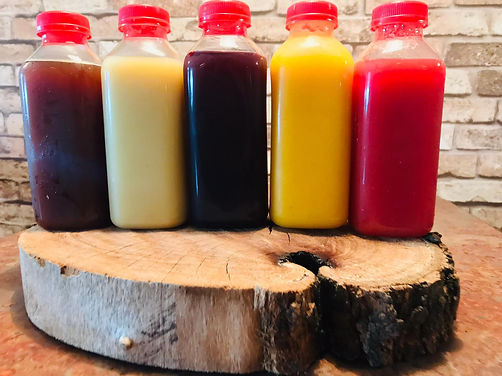
Assorted Drinks
What impact do you hope to leave on Columbia residents through Asanka Kitchen?
A. Thank you very much for that question. We want people to try the food but we also want people to know about West African culture and the history. We are having this interview but last Wednesday we had a food tasting here and I thought it was very important to not only tell them about the food and taste it but also let them know that West African cuisine has done a lot of good to Southern cuisine. As you can tell, all the West African countries are all posted on the wall. *Samuel goes on to list all the West African countries on the walls of the restaurant.* …Behind you is Liberia. You have Togo right there. You have Niger. You have Mali…. So, when people come in here, it’s not only knowing about the food but also knowing about West African culture. We want people to see us as a gathering place to not only enjoy food but to also talk about West Africa and possibly the entire African content too.
I think it is good that you all have represented West Africa in such a positive light through introducing the tastes of West Africa to Columbia. I am definitely grateful that you all are here and I feel like you being here makes our food scene more diverse.
A. That is the intent.
Because I do know of this restaurant and a Caribbean restaurant. I know of a Vietnamese restaurant and there is a Thai place that I like also. So I love that all of the world’s cuisines are being represented in Columbia and that you are contributing to that atmosphere.
A. Thank you very much. My wife and I want to thank you for this good will of helping to share our story so people can know what our intentions are. We appreciate you and please make sure you finish tasting the rest of the soups.
Me: Definitely. Thank you for your time.